|
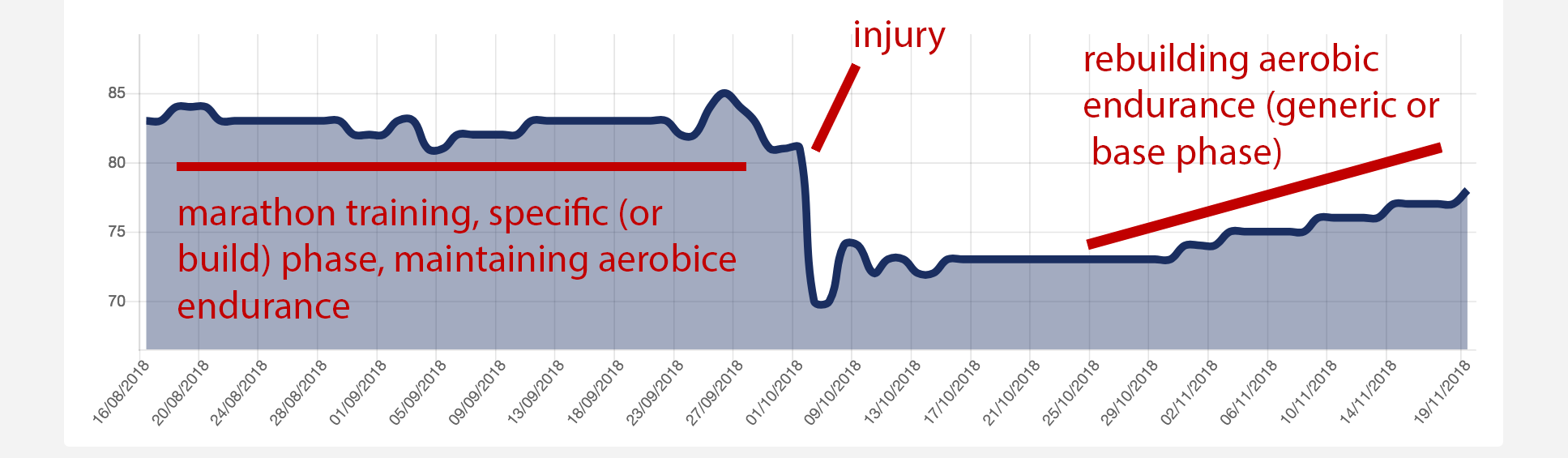
Blog post by Marco Altini We have released a new feature in HRV4Training Pro, Aerobic Efficiency Analysis for runners and cyclists. In this post, we go over the background, cover how you can use this feature to track changes in aerobic endurance as you progress in your training and also provide additional details about how this differs from other estimates we provide, and how you can benefit the most from this feature. A follow up of this work can be found in this blog post, where we cover cardiac decoupling. In case you want to jump right in, and check out our latest feature, simply login at HRV4T.com with your HRV4Training credentials. 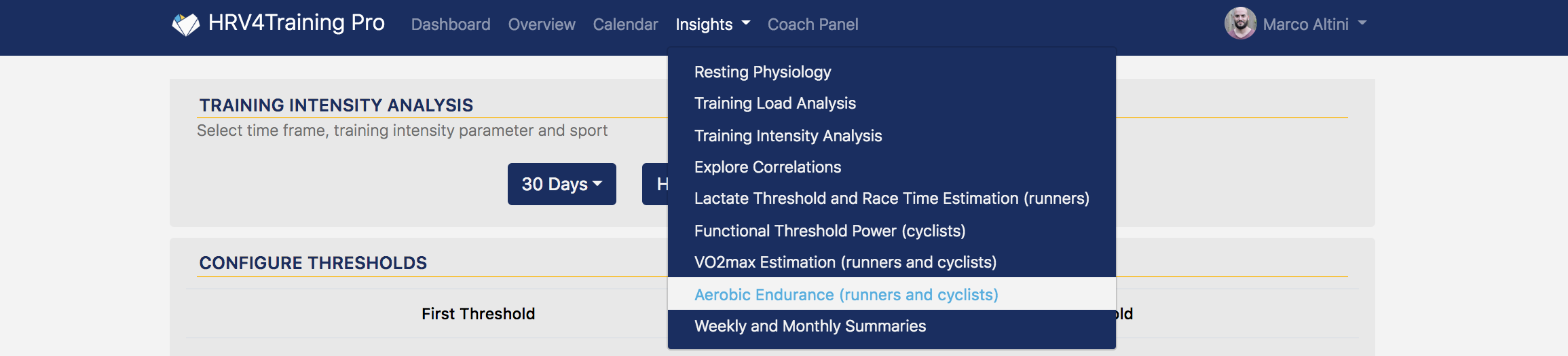 What's aerobic efficiency?Aerobic efficiency relates to your ability to sustain a given workload. Endurance athletes tend to have high aerobic efficiency, meaning that they can sustain a relatively high workload (for example pace or power), at a relatively low effort (typically measured in terms of heart rate). To determine your aerobic efficiency we compute the relation between output (pace or power) and input (heart rate). Intuitively, a lower heart rate for the same output (pace or power), when consistently shown over periods of weeks, translates into better aerobic efficiency. Similarly, a higher power or faster pace at the same heart rate, is linked to improved aerobic efficiency. By analyzing the relationship between input and output for running or cycling activities, you can easily track aerobic efficiency changes over time, as you progress with your training. What's the difference with VO2max estimation?If you are familiar with our work on VO2max estimation, you'll know that the same principle just explained, is also the principle behind VO2max estimates. In particular, the ratio between heart rate and pace or power is used as one of the predictors in the VO2max estimation model. You can learn more about VO2max estimation here. What's the difference then? While VO2max is a good marker of cardiorespiratory fitness and aerobic efficiency, the estimate depends also on parameters that have very little to do with actual aerobic efficiency and performance, for example body weight. Losing weight will increase your VO2max without necessarily improving your aerobic efficiency or performance. Additionally, there are factors that can only be partially accounted for when estimating VO2max. A few examples are: running on trails or difficult terrains, which reduces pace and makes your data not really representative of your fitness, very short workouts where heart rate does not reach steady state, very long workouts where heart rate drifts, environmental factors such as hot days or training at altitude, etc. - the list goes on. While many of these parameters are simply impossible to account for, what we can do is give you more control over what data is used to track changes in aerobic efficiency. In particular, via the panel below you can filter workouts and environmental factors so that the resulting data is more representative of your aerobic efficiency. You can also select how much data you'd like to use for each data point, for example selecting light smoothing, only this week of data will be used, while using average smoothing, which I recommend, uses 3 weeks of data.  The filtered workouts are also listed at the bottom of the page: 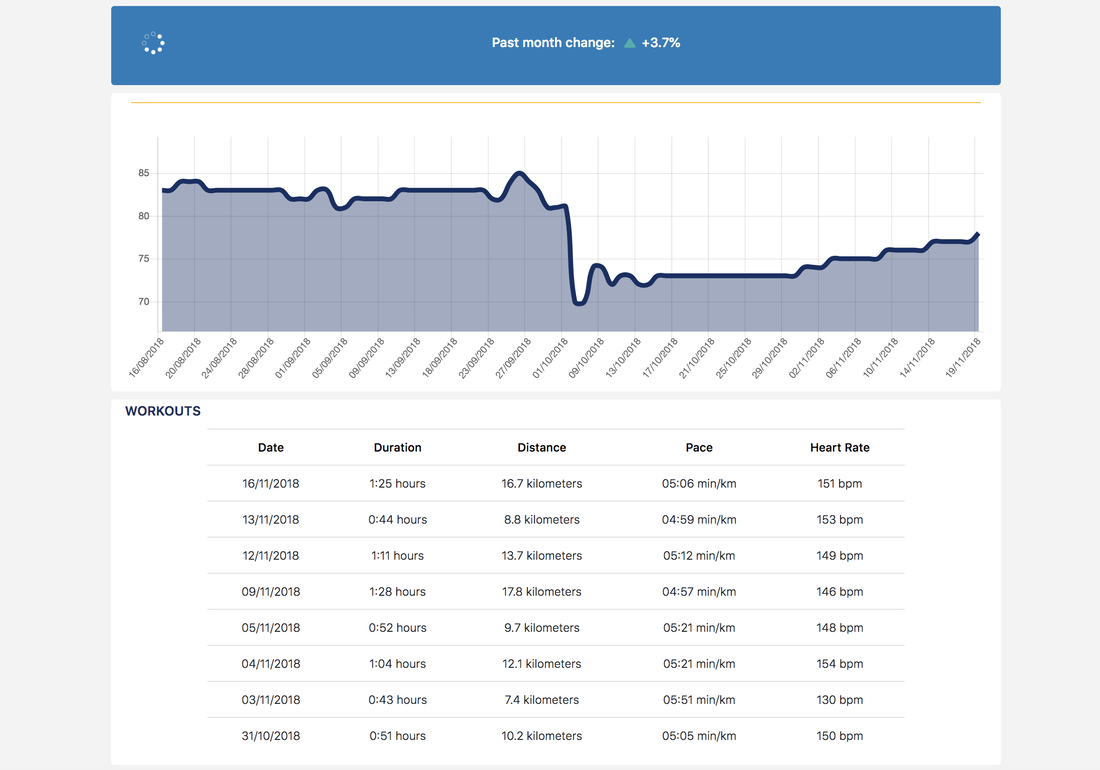 How can you use it?By selecting filters that are representative of aerobic efforts, for example low intensity trainings of about 30 minutes to an hour and a half, you should be able to track well changes in aerobic efficiency over time. This way, you can better understand if you are still making progress or if you have reached good levels with respect to your historical data, and are therefore ready to move towards a different phase in your training program. Below you can see an example for my own data, in which I set the following parameters:
You can see how the figure below shows very well a few aspects:
 Aerobic efficiency analysis at this stage is available only for runners and cyclists who connected HRV4Training to Strava or TrainingPeaks, and also train using a heart rate monitor (runners) and power meter (cyclists).
Enjoy! Comments are closed.
|


Register to the mailing list
and try the HRV4Training app! 

|
